Why Does Creatine Make You Bloated? (And How to Avoid It)
Bloating is the single most common reason people quit creatine. Here's what's actually happening, and what a different format changes.
It's Not in Your Head
Feeling puffy, uncomfortable, or bloated within the first week of starting creatine is a genuinely common experience, not an unusual reaction. It's the single biggest reason people quit the category or never try it again after a bad first attempt.
Why Monohydrate Causes Bloating
Creatine monohydrate is the most studied form of creatine, and it works by drawing water into muscle tissue. That's part of how it supports strength and performance, but for a lot of people the same water-retention process shows up as bloating, puffiness, or stomach discomfort, especially in the first few weeks.
This affects many people who take monohydrate, but not everyone reacts the same way. Dosing, hydration habits, and individual sensitivity all play a role in how noticeable it is.
Why Some People Feel It More Than Others
A traditional "loading phase," where you take a much larger dose for the first five to seven days, tends to make bloating more pronounced early on. So does taking creatine on an empty stomach, or mixing it with water and drinking it quickly rather than spreading intake out.
None of this means creatine itself is the problem. It usually means the format and protocol are working against the person taking it, not for them.
What Creatine HCL Is, and Why It's Formulated Differently
Creatine HCL (hydrochloride) is a different salt form of creatine. It's generally more soluble than monohydrate, which is part of why it's typically taken in smaller doses and doesn't require a loading phase. Skipping the loading phase, on its own, cuts out one of the biggest early bloating triggers.
This isn't a claim that HCL is a stronger or more effective form of creatine than monohydrate; the goal isn't a bigger dose, it's a gentler one. It's a different formulation aimed at the format-level reasons people quit, not the underlying benefits of creatine itself.
Why We Built OKO as a Gummy
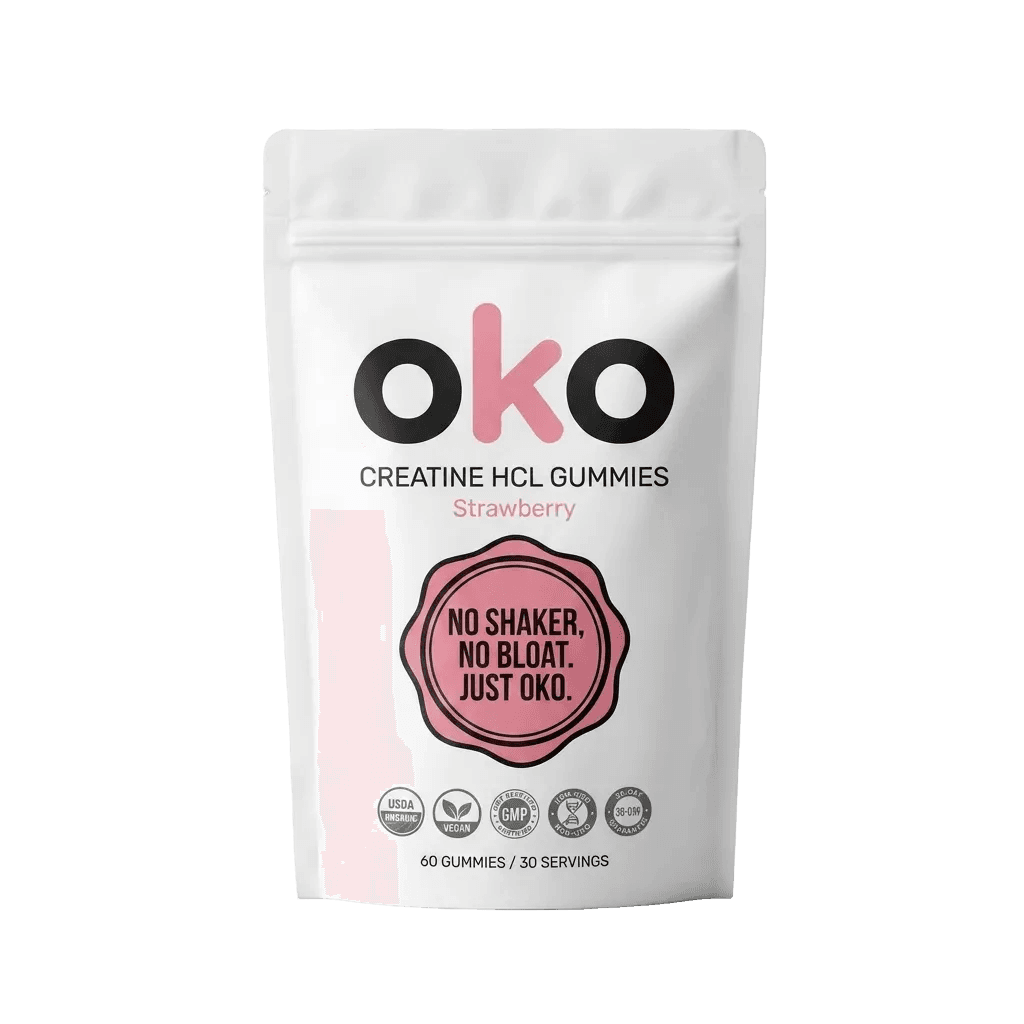
Bloating is one barrier. Mixing powder into water, carrying a shaker bottle, and dealing with a chalky texture every day is a second, separate one. OKO uses creatine HCL specifically because it's formulated to be gentle on digestion, and it's a gummy specifically to remove the mixing and mess that makes a daily habit harder to keep than it needs to be.
What to Expect When You Switch
Individual responses to any supplement vary, and switching formats isn't a guarantee that every past reaction disappears overnight. What a lot of people do report is that a gentler formulation, taken consistently, is easier to stick with than the version that made them quit the first time.
If OKO isn't the right fit for a given routine, that's what the 30-Day Money-Back Guarantee is for.
Ready to try creatine without the bloat?
Shop OKOFrequently Asked Questions
Does creatine HCL cause less bloating than monohydrate?
Creatine HCL is formulated to be more soluble and is typically taken in smaller doses without a loading phase, both of which are factors linked to less water-retention-related bloating for many people. Individual responses still vary.
Is creatine HCL better for sensitive stomachs?
OKO's creatine HCL formula is designed to be gentle on digestion, which is why it's formulated the way it is. It's not a guarantee for every individual, since digestive sensitivity varies person to person.